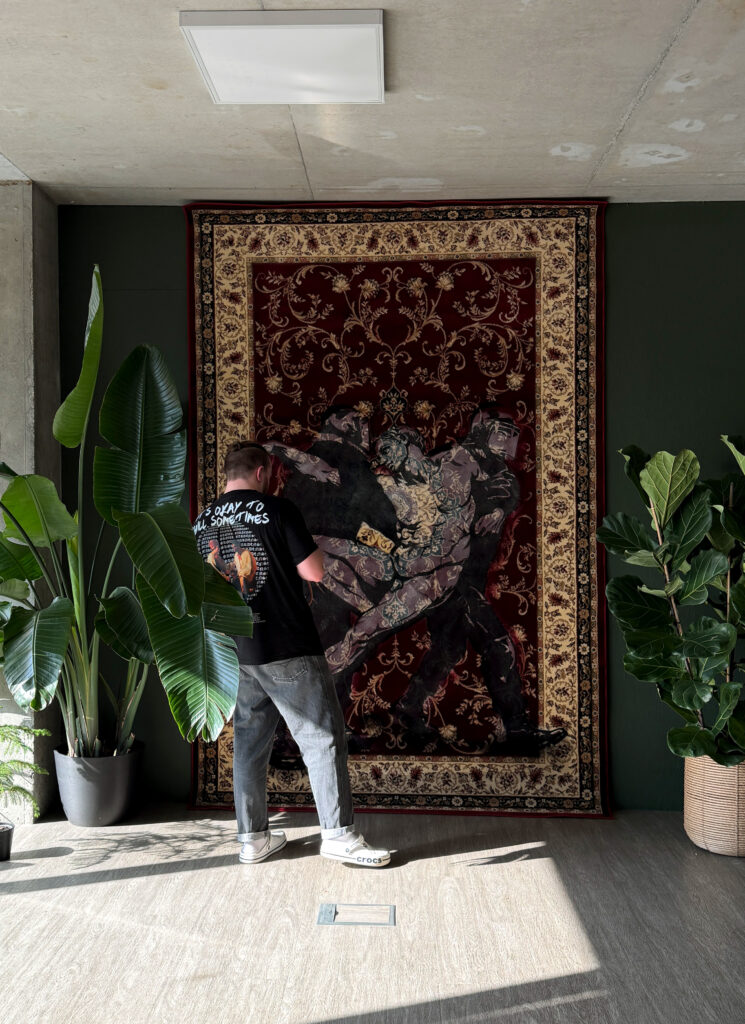
The first rug belonged to a grandmother.
It started with a rug that belonged to a grandmother, and a family with buckets on their heads. We used to paint on walls.
It moved with us from city to city, until one day a family appeared on it — a man, a woman and a child, each with a bucket on their head. Where that rug is now, nobody knows. Everything started there.
We used to paint on walls. Now we paint on rugs.
A rug is warmth, pattern, tradition. An object that has done one thing for centuries: lie there and keep quiet. We take it and leave a mark. It is an act of vandalism — and at the same time a finishing touch, because perfection has no limit. The figure becomes the ground. A pattern nobody looked at suddenly looks back.
The Renaissance was the great age of painting. We take its images and lay them down the way the modern world lives: rough and fast.
Every work follows the same path. The rug is chosen. Sheared. Singed. A sketch is drawn, a stencil is cut, the paint goes on. Then — nothing. Then it is finished.
The works are born in an attic, in a small town in Galicia, Eastern Europe. Who makes them matters less. What matters is what you feel when you walk past a year later. The rug lies in your home and reminds you: life goes on, and you change. It doesn’t.
Drovianni, from Galicia
One person, an attic and a pair of hands. You are looking at the back of a head because the work is in front of it, which is the right way round.